Monday, December 19, 2011

Winter Break 2011-2012!

It's finally here! It's a few days before my Winter Vacation and I've compiled a list of things I want to do. So now I ask--What would you do in these locations?

So close...

Itinerary:

  • December 21, Kokura-Osaka
  • December 22, Osaka-Manila
  • December 27, Manila-Boracay
  • December 30, Boracay-Manila
  • January 2, Manila-Macau
  • January 3, Macau-Hong Kong
  • January 8, Hong Kong-Seoul
  • January 9, Seoul-Fukuoka
Things to do:
  • Show off my Japanese to my friend in Osaka
  • Eat lechon
  • Go to at least 2 restaurants as seen on No Reservations (Travel Channel)
  • Scuba Dive in Boracay (2 dives)
  • Surf in Boracay (waves permitting)
  • Get a cheap massage on the beach
  • Find the smiling horse on a Red Horse
  • Order food in Tagalog
  • Gamble at the largest casino in the world, The Venetian, Macau
  • Eat dim sum
  • Eat until I'm full and keep eating
  • Chow Fun, Roast Duck... did I mention dim sum?
  • Get a "real" American Pizza (Pizza Hut or better)

The real reason I'm going to the Philippines...

What am I missing?

Tuesday, December 13, 2011

At the 38th Parallel

I don't think words can really describe the tense atmosphere. While there is undeniably a touristy feel, you notice a stark contrast that separates visiting the DMZ from a usual tour. Even after, I haven't been able to adequately put into words the feelings I had while visiting the area. So instead of delaying this post any longer, I've decided to present the 5 pictures that best portray my experience of visiting the Demilitarized Zone from the South Korean side.

Such heavy surveillance. Don't they realize they can just go look on Facebook?

This is the actual border in the Joint Security Area (JSA) of the DMZ. Notice the 3 Republic of Korea (ROK) soldiers standing at attention. The 2 at half profile are both protecting themselves so they're a harder target and giving themselves the ability to signal behind them if needed. In the front, there is our US Army sponsored tour guide. The two blue buildings are conference rooms where negotiations can (and have) taken place. In between the two blue buildings, you see a concrete line--that's the border itself. If you look way off in the distance, you can seen directly facing us a North Korean (Korean People's Army) soldier. He is watching our every movement through binoculars.

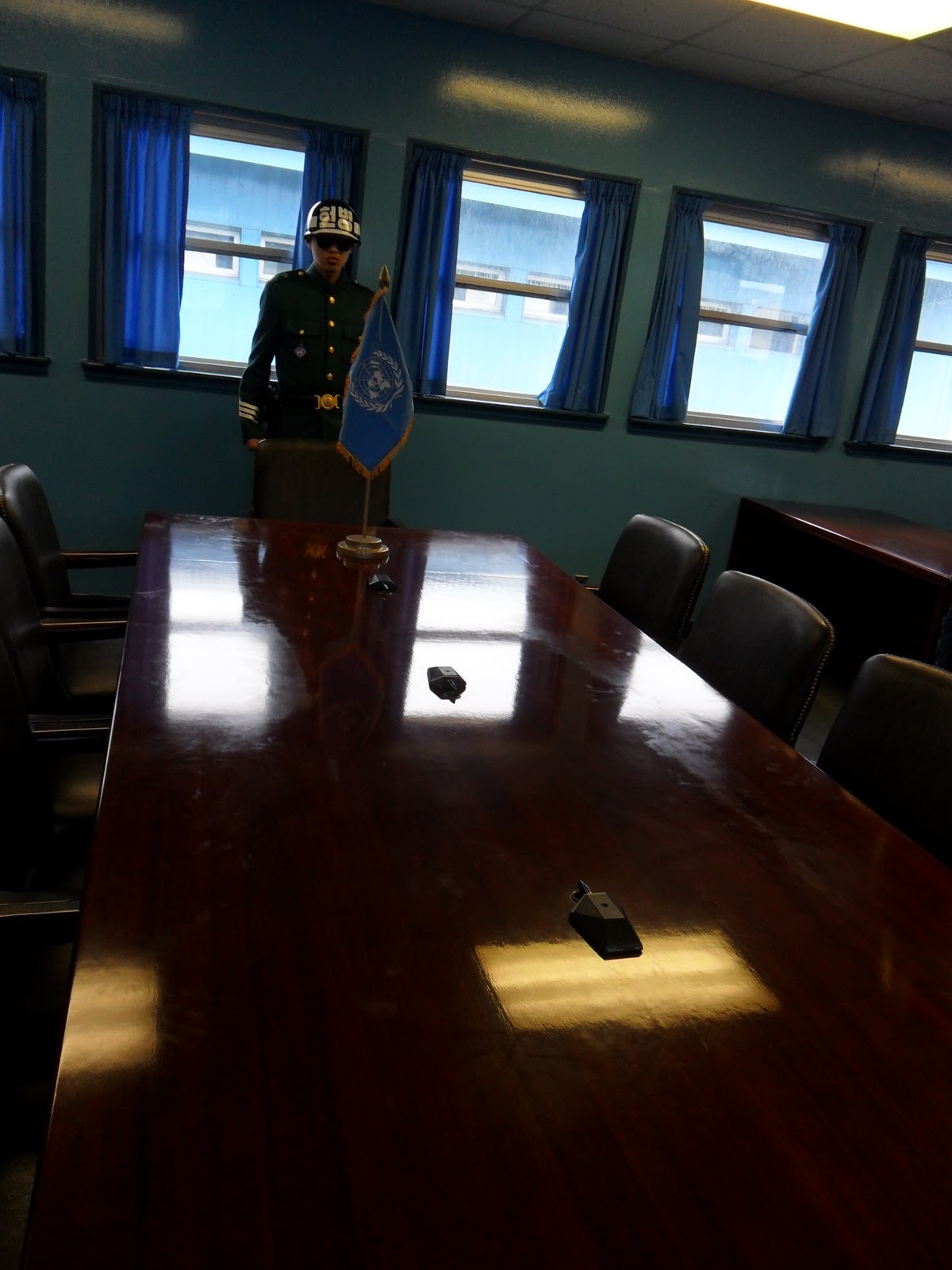
Apparently, the microphones are left on to record everything in the room. I'm sure we gave someone a few fun things to listen to.

Here's a view from the center of one of the rooms. The microphones on the table represent the border separating North from South Korea. This is along the same parallel as the concrete line just outside. Note that this photo is still within the South Korean border.


How childish. I mean, not like that'd stop us, but still.

And of course, we had to do the typical tourist pose inside the conference room, standing at attention with an ROK soldier. Both of us are technically in North Korean territory since the building is split in the center and we're on the other side of the line. As my travel partner pointed out, though, no passport stamp for crossing this border...

When I'm back, I hope it's as a passenger.

Right next to the JSA is Dorasan Station. If and when North and South Korea are reunited, it will serve as the connection between Seoul and Pyongyang. But perhaps more importantly, once operational, it will also connect the Trans Siberian Railway line to South Korea. In other words, you could take a train from London all the way to Busan, or the southern tip of the Korean Peninsula! But as of now, it sits unused, and overland travel via train from the rest of Asia to South Korea remains but a distant dream.

Not going to lie--playing on railroad tracks is a lot of fun anywhere in the world

And lastly, here we are on the tracks to Pyongyang. Next time...


Wednesday, November 30, 2011

Running in Japan vs. Running the US

So here is a short list of differences and similarities between my experiences running the Yodogawa Osaka Marathon this past November and the Los Angeles Marathon 3 years ago. It's not comprehensive by any means. However, these are the observations that struck me the most.

The Differences:
1. Everything's in Japanese. 
You may say, "Well, obviously. You're in Japan." Seriously, though, if we couldn't speak/read Japanese, this marathon would have been extremely difficult to apply for and figure out the day of. Not that I was really expecting a lot of English since it wasn't an international marathon, but still... it's the little things you notice, like the directions to put on your bib, the route markers, and even the pre-race countdown, are all in Japanese.

2. Japanese love to party. A marathon is just as good as an excuse as any. 
I noticed it at the Himawari Relay in May when I did a fun run, and I remember doing the same during a 12-hour swim relay. I figured it's because they're both for fun, people bring out the grills, have lots of food, and drink up. In both of those cases, though, participants too joined in on the drinking and having fun. Along the marathon route, supporters were there... barbecuing and drinking for their own fun. Not that I have anything against that, but it is sorta disheartening run past a group of people partying and not being able to (read: shouldn't) join in the fun. Unlike other events I went to, it wasn't for the runners. It was for them.

3. Everyone seems to have spent a lot of money than me. 
I've seen it while surfing, snowboarding, and any other activity I've done in Japan. You can't say they skimp out on equipment, whether it's clothes or other products.
A specific example: when I went hiking in Yakushima, I noticed that everyone had nice hiking boots, Gortex rain jackets and rain pants, and backpacking backpacks. It made me wonder, though, how much of it is brand new? How many people know how to use them and how many people are using these items because "it's what you're supposed to do?" I even saw people wearing gators. Do you know what gators are for? They didn't. (Note: They're a sort of cover for your boots so rain or snow so water doesn't get in.) One last thing I want to mention about Yakushima... this was on a sunny day.

Here I am wearing 400 yen basketball shorts and the same shoes I wore for my first marathon 2 years ago...

I know there were people genuinely better prepared for the marathon than I was. There were lots of people who take running a lot more serious than I do. But when everyone is sporting the latest in "running technology," you have to wonder how many of these people bought special clothes, food, or drinks because "it's what you're supposed to do."

OK, enough of my ranting. On to the similarities.

The Similarities:
1. There is an immediate camaraderie between runners before, during, and after.
Everyone knows what everyone else is feeling. The anxiety before. The immense pain during. The exhaustion after. It's these shared experiences that makes it so easy to relate to each other. How can you not interact with others in the same situation as you, whether it's giving (or ignoring) other people's last minute tips or cheering for complete strangers.

And on that note,

2. It's still running.
Or maybe better put--there is a point when it stops being "running in Japan" or "running in the US." It's simply running. There are no more cultural differences at the 40km mark. There are no judgments or cynical observations when you "hit your wall." When your body shuts down, the fatigue becomes all-consuming, and you can't go anymore... all that's left is you. Your race. And when you push past that and cross the finish line, it all becomes worth it. The feeling of accomplishment: that's the same, no matter the continent.

Clearly a "before" picture... there's no way we looked this good after.

And perhaps most importantly,

3. Chicken McNuggets are the perfect post-race meal.
'Nuff said.


Thursday, November 24, 2011

Kokura Konbini Challenge (小倉コンビ二チャレンジ)

So here's a game for all you here in Japan. Bored and broke? Try the Kokura Konbini Challenge! As long as the weather's fair and you have 1000 yen, you can play this drinking game anywhere there are コンビ二. All it it requires a bit of skill and a bit of luck. Home-field advantage helps a lot too.

The Rules:
  1. In turn, each player takes turns acting as a guide to a konbini. After you lead the group to one konbini, it's the next player's turn to lead the group.
  2. You must buy a drink (12 oz./330mL) at each konbini you visit.
  3. You must finish your drink before the next konbini.
    • If the guide has finished his/her drink and no other player has finished their drink, and the group has arrived at the next konbini, the guide gets a free pass (i.e. doesn't have to drink the next round)
    • If the guide hasn't finished his/her drink and at least one other player has finished their drink, and the group has arrived at the next konbini, the guide must drink double (tall can 500mL)
  4. You must go into the next konbini you pass whether intentionally lead there or not. 
    • If the konbini is within eyesight and on the same side of the street, it counts as passing by it.
  5. No two same konbini types in a row. No same exact konbini in a night. (ex. You can't go into any 2 Lawsons in a row, but going to a Lawson, 7-11, and then a different Lawson is ok.)
    • If the guide breaks either rule, he/she must buy the next round for all players.
  6. Bonus rule: No buying the exact same drink in a night. (Same kind of drink is ok.)


Let me know how it goes. If you remember, that is...


Sounds easy? 
As a reference, there are 2 inside the station, 1 behind, and another two blocks in front... and that's just for Family Mart.

Notes:
Oldest player starts first.
The game is over at the last train/bus. Or someone gets sick. Whichever comes first.
Drinks must be 5% or better, but while Tsingtao isn't 5% and neither is any light/calorie-off happoshu, that doesn't mean play this game with Strong Zero (8%)

Wednesday, November 23, 2011