Showing posts with label South Korea. Show all posts

Monday, February 27, 2012

Kicks in Korea

There is something distinctly different about the fashion found in South Korea versus that found in Japan. Some of the most noticeable is a more North Face or other typically "outdoors" jackets, less layers of makeup on girls, and more baseball hats on guys.

Another: the sneakers.

In Japan, guys don't really care too much about shoes. This is a culture where wearing a suit is key for work as well as social functions. Yet, men will wear sneakers, crocs, and other non-dress shoes while in a suit and tie. (This happens more often than not when you need dress shoes for outside, but you need to change into indoor shoes for school or some other institutions.) So in informal settings, shoes don't matter--any sneakers will do.

Women in Japan wear heels (let's say, as a made up statistic, 90% of the time). That's it. As a man, it makes me spoiled--in the US, heels are reserved for special occasions, so seeing women wearing heels all the time is a huge plus. As a woman, though, it must be terrible on your feet day in and day out, even in casual settings.

This is where Korea is different for both sexes. Men and women both dress to impress, but also for comfort. There's a weird take on American fashion that goes on with all the puffy jackets and rain gear. But with shoes, they get it right. Everyone wears sneakers. All the popular brands are represented--Nike, Adidas, Converse, Vans, as well as much more expensive names. Sizes, shapes, styles, and even colors are so much more diverse than the usual black and brown in Japan.

I'm not even into shoes. But after a few wins on roulette at Seven Luck Casino...

Only 2 are mine, I swear.

In 2 days, the 3 of us bought 7 new pairs of shoes... just doing it like the locals.

Tuesday, December 13, 2011

At the 38th Parallel

I don't think words can really describe the tense atmosphere. While there is undeniably a touristy feel, you notice a stark contrast that separates visiting the DMZ from a usual tour. Even after, I haven't been able to adequately put into words the feelings I had while visiting the area. So instead of delaying this post any longer, I've decided to present the 5 pictures that best portray my experience of visiting the Demilitarized Zone from the South Korean side.

Such heavy surveillance. Don't they realize they can just go look on Facebook?

This is the actual border in the Joint Security Area (JSA) of the DMZ. Notice the 3 Republic of Korea (ROK) soldiers standing at attention. The 2 at half profile are both protecting themselves so they're a harder target and giving themselves the ability to signal behind them if needed. In the front, there is our US Army sponsored tour guide. The two blue buildings are conference rooms where negotiations can (and have) taken place. In between the two blue buildings, you see a concrete line--that's the border itself. If you look way off in the distance, you can seen directly facing us a North Korean (Korean People's Army) soldier. He is watching our every movement through binoculars.

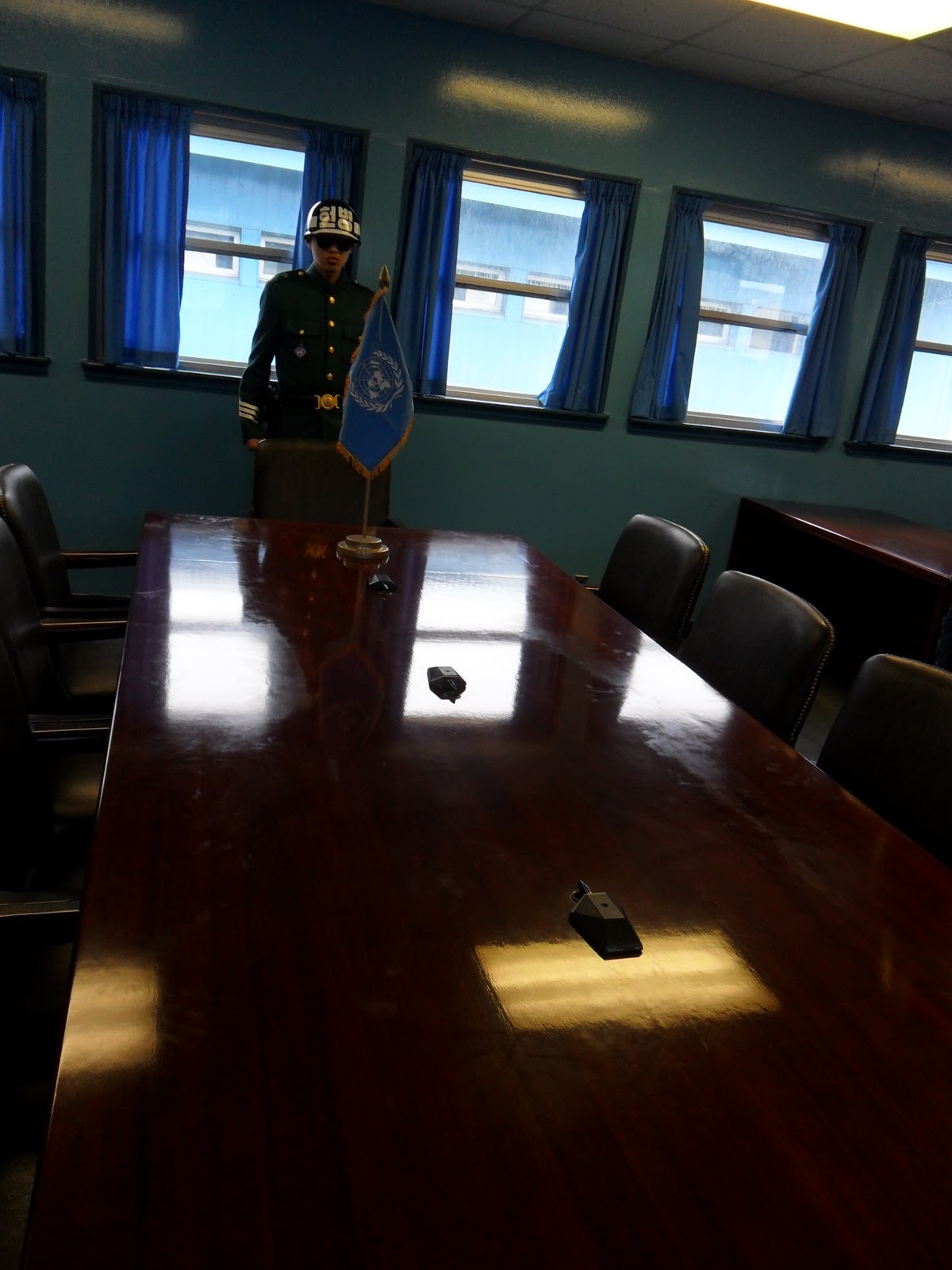
Apparently, the microphones are left on to record everything in the room. I'm sure we gave someone a few fun things to listen to.

Here's a view from the center of one of the rooms. The microphones on the table represent the border separating North from South Korea. This is along the same parallel as the concrete line just outside. Note that this photo is still within the South Korean border.


How childish. I mean, not like that'd stop us, but still.

And of course, we had to do the typical tourist pose inside the conference room, standing at attention with an ROK soldier. Both of us are technically in North Korean territory since the building is split in the center and we're on the other side of the line. As my travel partner pointed out, though, no passport stamp for crossing this border...

When I'm back, I hope it's as a passenger.

Right next to the JSA is Dorasan Station. If and when North and South Korea are reunited, it will serve as the connection between Seoul and Pyongyang. But perhaps more importantly, once operational, it will also connect the Trans Siberian Railway line to South Korea. In other words, you could take a train from London all the way to Busan, or the southern tip of the Korean Peninsula! But as of now, it sits unused, and overland travel via train from the rest of Asia to South Korea remains but a distant dream.

Not going to lie--playing on railroad tracks is a lot of fun anywhere in the world

And lastly, here we are on the tracks to Pyongyang. Next time...


Friday, September 2, 2011

A Series of Unexpected Events

So there we were in Seomyeon, Busan, in South Korea. Being my second time, I didn't really care too much for the touristy aspect--for me, this was an inexpensive trip for drinking, eating, and shopping (in that order).

As such, we found ourselves outside on Saturday after an evening of drinking games at Thursday Party and Miller Time. While stumbling back to our hotel, someone suggested we go clubbing. Unsure of where to go, we ended up asking a random guy coming out of a bar. After failing to give us directions in Korean, he said (I'm guessing) that he'd show us where before heading off.

If only we had known what we were getting ourselves into...

All the neon should have been our first warning...


First thing that stood out to me--we had to buy a table. No choice. Even though we pointed to the dance floor to say we wanted to dance only, we were taken to a table and had to place an order. Thankfully, there was no cover (or rather, our $15 each for a beer, water, and snacks was our cover).

This leads to the second thing that was weird. Even though the club was huge, the dance floor was really small. Why were there so many tables throughout the club, and why were there so many hallways and doors leading to... karaoke rooms? VIP rooms?

No matter. We went out on the dance floor to do our thing. At least that would be normal, right?

Except there was something off about the dance floor as well... why were guys and girls awkwardly segregated like a middle school dance? And why did two male dancers appear on stage, start taking off their clothes, and make me question what kind of club we were at? Furthermore, why did everyone seem to know each song and dance in unison like a music video? And why was it that every 20 minutes, the DJ would play a slow song, the lights would dim, and instead of couples pairing up to slow dance, the dance floor would completely empty?

Moments before clothes start coming off... 

Back at our table during one of those random drinking breaks (as we decided to call them), we pondered the answer to all of these questions. And then we noticed something else that was weird. There were an unusually large number of hosts or servers leading girls around to the VIP rooms. As in, they were taking them by the arm or hand, and then dropping them off to meet whoever was inside.

Again, this caused us to question the kind of... establishment we were in. Did these seemingly innocent girls actually work for the club? Did we accidentally stumble across a hostess club? An escort bar? An underground brothel?

It turned out (we asked the owner of our hostel later), this was actually a certain kind of Korean nightclub. You dance with the friends you came with, but groups don't really mingle. There are occasionally performers as entertainment onstage. In our case, the exotic male dancers were actually a pretty famous hip-hop team (they could have fooled me). The reason for the slow song breaks? It's a chance for you to go back to your room, and you ask the hosts to bring you some girls you'd like to meet. If the girls don't like the room, they can always leave (though we did see one girl being chased by a guy as she stormed out of a room). This also explained why some girls would leave a room, only to be snatched immediately by a host to be taken to another. It's like speed-dating Korean-style.

So it was no wonder why all the girls were totally checking my friends and I out. They wanted us to invite them to our (non-existent) VIP room for some... stimulating conversation.

Well, that, or they were staring at our ridiculous attempt at copying their dance moves.

Now just imagine the entire dance floor doing this. (Starts around 4:25)
And not just the girls...


Monday, August 22, 2011

Saju Reading in South Korea

I want to say I don't believe in superstitions. That means astrology, horoscopes, tarot cards, palmistry, all of them, I've never believed in.

So when our host and owner of Zen Backpacker's Hostel in Busan, June, told us he can give us free fortunetelling, we skeptical at best. However, it was just a harmless fortune and it's not like we had to believe them. At the very least, it'd be a fun way to pass time before our night out on the town.

The 5 Elements of Saju

Perhaps I should explain his method of fortune telling. It's called Saju or the four pillars method. It requires your birth year, month, day, and time. Within each category, there are two corresponding characters based off of the Chinese Zodiac. These form the four pillars. Each character has one of five elements. Each element represents a season: Spring is wood, Summer is fire, Autumn is metal, and Winter is water. This makes sense, but what is the fifth element? In between Summer and Autumn is the mediator, Earth.

After inputting my birthday specifics into a computer program, June was able to see right away something different about my reading. Out of 8 possible (4 pillars of 2 symbols each), 5 were yellow. I was a majority Earth.


Like the idea of yin and yang, ideal people should be balanced. As Four Pillars Korea says, "Saju is the four pillars of destiny. If we consider the five elements as a happy life, the four pillars make the destiny of a life incomplete." I'm not. Not even close. The fact that I'm mostly Earth meant several things according to June.

His biggest takeaway for me is that life comes easy. I am skilled at many things and can adapt easily. When he  asked what my future prospects is and I responded with, "I don't know," he said that's good. It's better that way so I can pursue anything when the opportunity comes.

June also mentioned that people look to me for leadership (he mentioned that the current Korean President has a similar reading) and people will "bow" down to me (his word, not mine). In other words, it's easy to influence people to do things and I'm influential in my circle of friends.

The downside, though, is that it may make me lazy. Because I don't have to worry, I don't work very hard. Like the current President, he's not super successful or spectacular but at the same time, no one has any complaints about him. There's flexibility in my life to an extent but he mentioned that because of this, I can be too picky. A lot of opportunities present themselves to me but I have a hard time focusing on one. I pass up a lot of chances that other's would have taken.

After he finished with me, some of my other friends got their fortune told too. It was interesting hearing each other's fortunes--we all had a good laugh about the predictions and personalities traits he described. One thing I could shake though, was how mine seemed scarily accurate. How much of it was true and how much of it was me making his reading fit me? I'm not sure, but it hit me hard enough for me to decide to write a blog post about it.

So here's to my fortune and seeing where fate takes me. And I'll work on being less picky but no guarantees...

Thursday, February 24, 2011

How I Learned to Read Hangul... in a Morning

While looking into different things to do in Busan, one thing that I kept reading is that I ought to learn how to read Korean. You may not know what it means, but since it's an alphabet (versus, say, kanji in Japanese), you can sound it out. Many travel blogs mentioned it's usefulness at restaurants and navigating street signs. Due to my inherent laziness, I didn't bother looking into it until the last day (literally the morning of my flight). I wasn't going to, but since I found myself with some free time in the morning, I figured I'd take a stab at it.

While looking online at different explanations, I stumbled upon this.


These pictures did little to help me though. I mean seriously... let's look at the first one, ㄱ, for G. How is their example, "G as in Games," relate in any way to the picture? It doesn't. Furthermore, after looking at this picture, I got even more confused. The characters on this chart and actual Korean writing looked nothing alike. There were similarities, but actual writing looked much more complex. 


One quick Wikipedia search later, I learned that syllables are formed using a combination of the above characters. Instead of forming words with letters like in English, their letters combine to form syllables. The chart shows how to break down the character into its components. Things were starting to make sense... but I still needed a way to memorize the basic characters unless I wanted to carry a chart around with me all the time.


I decided that I should create my own method for memorizing each letter. Below is the way I memorized it and though it may not be useful for you, it shows that we all learn differently. As in, my brain can make some pretty random pictures out of nothing and draw connections where there aren't be any. Some are more of a stretch than others, but meh... it worked for me.


(The Hangul [Korean writing] is first, followed by the expression I used to remember it. In parentheses are the pronunciation and the logic or lack thereof for the expression)


Consonants:
  • ㄱ - 7 Grand (Pronounced G, but it looks like a 7, doesn't it?)
  • ㄴ - NULL/LAN (Pronounced N, but looks like an L. My logic isn't always straightforward.)
  • ㄷ - DoC (Pronounced D. Looks like a C. DoC as in Doctor....?)
  • ㄹ- 2 Low (Pronounce L. Looks like a 2, as in, at a club, "Damn, girl... you're gettin' 2 Low.")
  • ㅁ- Mouth (Pronounce M. Reminds me of Japanese kanji, 口, for Mouth)
  • ㅂ - Bull (Pronounced B. Looks like a Bull with horns)
  • ㅅ - 人 Same thing (Pronounced S. As in, Japanese kanji has the Same thing 人.)
  • ㅇ- ONG Bak (Pronounced Ng, as in, O for ONG Bak, the Muay Thai movie.)
  • ㅈ - ス  (Pronounced J, reminds me the character in my name, ジャスティン.)
  • ㅊ - 小さい (Pronounced Ch, as in 小さい, which kinda looks the same... if you squint really hard...)
  • ㅋ - Quick (Pronounced K, but looks like a lowercase q. The K sound in quick [kwik?]).
  • ㅌ - ET (Pronounced T, but looks like an E as in ET.)
  • ㅍ - Part II (Pronounced P, looks like Roman Numeral II.) 
  • ㅎ - Hat (Pronounced H, looks like a guy wearing a hat.)

Vowels:
  • ㅏ - "Ah, zombie!" (Pronounced Ah, Looks like a zombie walking towards this sentence)
  • ㅓ - "Uh, what?" (Pronounced eo, or uh. This guy is facing away from the zombie and is confused)
  • ㅗ- "Oh, I died." (Pronounced Oh, looks like you died from the zombie.)
  • ㅜ - "You fail." (Pronounced u, or the end of yOU. You died, but running away and fell on your face)
  • ㅡ - Eu... (Pronounced eu, as in "Euh... je sais pas." The French version of "umm... I don't know.")
  • ㅣ- I (Pronounced eeh, but looks like Japanese い, which in romaji is I).


Let's take the example, 비빔밥. Looks simple enough. The first syllable, , is a bull and an I, spelling 'Bi.' The second syllable, is the first one but with a third consonant at the bottom, , which looks like a mouth, M. The second syllable is 'Bim.' That leaves the last syllable. There is still a bull, so we know it starts with B. The vowels is the zombie, Ah. The last letter is another bull (which actually changes to a p, but if you pronounced it with a b, it'd probably be understood). The full word is bibimbap, or the best cure for a long, soju-filled night.

With my new mnemonics, I hopped on the plane to 부산. Armed with my new, rudimentary understanding of한글, I was able to impress some new Korean friends, pick the right bus to the airport, eat at locals only spots, and perhaps most importantly, pick out the 갈비 onigiri at convenience stores.


All in all, a productive morning.

Thursday, February 17, 2011

A Different Kind of Tourism

I have traveled to my fair share of cities. As such, I've found that in more touristy areas, the industry is designed to serve a diverse group of people, particularly when it comes to foreign languages. For example, many restaurants I visited in Vietnam had menus outside in English, French, and Japanese, with signs in Russian and Chinese (indicating they can speak them as well, I'm assuming). However, all the places I've been to in the world have catered to some sort of English speaking population. Whether it's geared towards British tourists in France, Australians in South-East Asia, or Americans in Mexico, if a place is touristy, it'll have a decent English speaking ability.

That's not to say that everywhere can (and should) speak English. When you travel off the beaten path, you'll discover that the simplest act such as ordering food becomes an adventure if you can't speak the local language. That being said, if you stay on the main drag and visit the places meant for tourists, English is your best bet.

Haedong Yonggungsa Temple, Busan, South Korea

Busan is the exception.

We went out one night to an international party. It was hosted at a cafe that during the day, offers a language exchange of sorts with local university students and foreigners. On Friday nights, though, it turns into a party. Thanks to its prime location between two Universities, its proximity to our hostel, and the all-you-can-drink beer for about $12, it was the perfect chance to meet some locals.

Our table was mostly Koreans. There were a few guys who were in the Air Force. They spoke Korean and some knew a bit of English. The girls, though, were all Japanese majors at one of the universities and spoke fluent Japanese... but no English. Guess what language we were speaking in most of the night?

In all seriousness, though, it was the best Japanese practice I've had during my time in Japan (well, in Asia). When the common language is no one's first language, there's no cheating by switching into your first. It also matters less when you make mistakes. Since neither of you are native speakers, you understand the other's difficulty with learning the language and feel less pressured to be perfect.

No joke--I spoke more Japanese in Korea than in Japan

Throughout the trip, Japanese trumped English numerous times. At Jagalchi fish market, we gorged on Korean sashimi. Our server started taking our order in English, but as soon as he realized that we spoke Japanese, he switched over since it was more comfortable for him.

The first night, we were playing beer pong with a Korean couple. We struggled to communicate with them in English as the guy only spoke a little, but his girlfriend couldn't at all. After one disastrous turn, Yannick and I were cursing at each other in Japanese. Instantly, they both switched to Japanese, and after that point, the conversation flowed smoothly.

At Burger King, the cashier struggled to understand my order of a cheeseburger and fries but as soon as Yannick ask for his order of フライドポテト, she took his order perfectly, even though the menu is written in Korean... and English.

It was such an eye-opening experience. Don't get me wrong--I've always believed that foreign languages are important. It shows interest in the country's culture to speak their language. However, I never thought that knowing any foreign language (foreign to them, not to me) could be more useful than English. For example, if I went somewhere, I wouldn't get by with French. Outside of countries that used French as an official language, the chances to use French decrease dramatically. English is much more likely to be spoken (ex. Take Vietnam, a former French colony. The only time I found French useful was talking to a French guy once. It never once helped me speak to a local).

Yet, Busan proved me wrong. It was the first place that English lost to another foreign language in terms of practicality and number of speakers. As I continue traveling, I'm sure it won't be my last.

And though I hate the idea of returning to the same place more than once, Busan may have to be the exception...