Friday, June 22, 2012

Fluent in Malaysia

What do you know about Malaysia? Do you know what's the national language of Malaysia? How about it's capital? Or that it's the largest practicing Muslim country in the world? What about even where is it on a map?

Before I went to Malaysia, I really didn't know much. It's not covered in our classes at any level of schooling unless you go into some sort of Asian studies (which I didn't). So after visiting, I went from practically zero knowledge to having so many different things I could rave about--the modernness of Kuala Lumpur, the cheapness, quality, and variety of food, or the friendliness of the people.

Obligatory picture in front of the Petronas Twin Towers

But the one thing that shocked me the most, more than that in a country whose official language is Malay, you can use English without any guilt.

To put it in perspective--in the Philippines, where English is actually a national language, I felt embarrassed speaking English. Being Asian in an Asian country, you get looks when you don't speak the same language locals do. This goes for China, Japan, South Korea, Vietnam... pretty much anywhere (except maybe Hong Kong or Singapore), you get funny looks. Why is this local guy not speaking back to me? Oh... he must be from somewhere else. When I went to the Philippines, it's worse. Because a lot of Filipinos can speak basic to fluent English, but using it is a sign of  wealth/status, it's different than other Asian countries. Instead of asking where you're from, it's more, why aren't you talking to me in Tagalog because you clearly (look like) know it? Why are you acting so stuck up? It's borderline disrespectful to use English over Tagalog.

In Malaysia, I blend in. But instead of being talked to in Malay or even Chinese, it's English first. It's weird, but because there are so many different kinds of people in Malaysia, the default language to communicate in is English, no matter how rudimentary it may be.

I had the fortune of getting a behind the scenes look at a TV channel 8TV. Although its demographics cater to the younger generation (think along the lines of MTV), I couldn't help but be impressed by the use of English. Here, in Malaysia, where the official language is Malay, everyone uses English, both onstage and off. One of the shows I got a behind the scenes look at was called Showdown, like Malaysia's version of America's Best Dance Crew. The announcers spoke mostly in English with bits in Malay to keep the show's bilingual status. More surprising, though, was that most of the team interviews were in English except maybe 2 teams who felt more comfortable in Malay. Even the one team who was ethnically Chinese preferred English for their post-dance interview. This was no exception either--when checking out clips from some of the other shows during a studio tour, I couldn't help but notice all the English.


 Converted control room for the Season Premier of Showdown


I know it may not be like that in the rest of the country (I only visited Maleka/Malacca and Kuala Lumpur), but what a strange, neat, and new experience--to use English when I wasn't expecting it. I still want to learn a bit of Malay (especially since it shares words with Tagalog), but at least for this trip, I can safely say that with English, I felt fluent in Malaysia.

Sitting at the judges' table for Showdown--friendly judge and mean judge

Tuesday, June 12, 2012

Aoshima, Miyazaki

As things start winding down on my time on JET here in Japan, it's time to start saying my goodbyes. And as the JET returner's guide says, it's important to not only work on your goodbyes to your friends, but to your favorite places as well. Bars, restaurants, local haunts, they're all important to make one last visit to.

For me, Aoshima will be the first of these goodbyes.

A small, sleepy town a short bus ride south of the city of Miyazaki, Aoshima is one of Kyushu's best secrets. More like Hawaii than Japan, when you step off the bus, it feels... different. The air is noticeably warmer and heavier. The sun is brighter and stronger. And the vibe is surprisingly chill.

Unlike some fashionistas in Fukuoka, the locals in Aoshima look remarkably more relaxed. High heels are traded in for sandals. And those annoying umbrellas to block the sun are instead replaced by spaghetti straps and halter tops? This is still Kyushu?

This stark contrast in culture can be attributed to one popular, local pastime:

Surfing.


Let's not get into how many attempts it took to get a photogenic picture of me actually surfing...

It's not like any resort town. Sure, it still has busloads of tourists that make the visit to the shrine or check out こどものくに. Yet, because they stay in their own all-inclusive resort/hotel and don't stray out of their own neighborhood, it doesn't feel like Aoshima's sold out. The beach, and more importantly, the waves, are still for the locals. While Japanese tourists from elsewhere rest in the shade, the locals are out in the water. Men, women, children, it's anyone's sport.

Another, perhaps the most shocking characteristic of Aoshima--there's no party. There are no bars outside of the big hotels. Definitely no clubs. Restaurants are hard to come by after 5PM. Stores will have been closed by then as well. People hit the water before work, open early, close early, and repeat the next day.

That's not to say the locals can't throw a party--the few times we managed to stumble on one, whether it was at an International Beer Festival or a concert/fashion show/fireworks, it was true celebration. Less like a drunken Spring Break mess, it was more like a block party. The whole town came out to celebrate. And in true, small town feel, everyone was friendly--we met locals and made friends with Aoshima-ites and would continue to see them each time we went.

We stayed at the same guest house each time--the Aoshima Pension. Instead of feeling like a hotel, it was like visiting Grandma. The owner would fuss over us each time, making sure we knew where to go, got enough sleep, and didn't go hungry. Even though we didn't pay for the meal plan, she would provide snacks when we arrived, rice balls for the trip home, おつまみ with our drinks, and even would give us back some of the money we spent for our room to buy ice cream and drinks for our return trip.

August 2011 - Aoshima, Miyazaki

In total, I've been to Aoshima 5 times within the past year, each time with a different group of people. This weekend, trip number 6, will be my last for a while. And while bittersweet, I can safely say that it's only a matter of time before I go a seventh. It may take 2 years or 20, but I will definitely be back.

But at least for now, it's time to say goodbye.

Thursday, May 24, 2012

Malay Wedding

I had the fortune of being invited to a friend of a friend's wedding while in Singapore. It was a traditional Malay wedding, and it was incredible. It was unlike anything I've ever seen before. This is also the most confused I've ever been in a while and... well, see for yourself.

April 29, 2012, Singapore


Tuesday, May 8, 2012

My First Durian

I figure it's appropriate after my foodie post of all the great food I ate in Singapore. Here's the only thing I wasn't exactly thrilled about eating.


You can almost smell it through the video. I know I still can taste it...


Monday, May 7, 2012

A Foodie's Nightmare

I know, I know. I had a post earlier about how "Hong Kong is truly a foodie's paradise." And it is--with exceptional Chinese/Cantonese food everywhere in every form, from the Michelin-starred to street food.

But if HK is a foodie's paradise, Singapore is a foodie's nightmare.

I'm not talking about nightmare in the sense of lack of food, a world with bland food that all looks and tastes the same. No, I'm talking about a different kind of nightmare.

One where there's no end. One where there's too much food.

The first and last time I'll be hungry the whole trip...


As a traditional melting pot of Chinese, Malay, and Tamil Indian cultures, Singapore has a wide variety of food. Add in more recent immigration from the rest of Asia, as well expats from the Western world, and you can find authentic food from just about anywhere.

Next, throw in the "Hawker Centre," a Singaporean government-sponsored institution to bring street food off the streets, sanitize it (but not too much), and sell it under open-air food courts. Mix in an influx of world renown chefs with these humble stall owners, as well as everyone in between, and what do you get?

Excess.

Too much to choose from. Too many flavors, styles, variations, dishes, cultures, and simply put, too much food.

How much is too much? Let's break down my brief sojourn day by day and you decide.


Day 1:

Starts out late as my flight got in around 10. Breakfast at a hawker center in Chinatown. Go for a tasty, yet touristy Singapore Sling at the Raffles Hotel right after. (Tip: Definitely a tourist trap at an overpriced $30, but with a Citibank card, it's 25% off, plus free peanuts that you can throw the shells on the floor!) Lunch at a hawker stall, Tian Tian Chicken Rice at 1pm, the version featured on No Reservations. Some fresh fruit before a quick game of roulette, and up $50 later at the Marina Sands Casino, it's time for an early afternoon cocktail at Ku Dé Ta on the top of the Marina Sands Hotel. Quick stop for boba (Bubble Tea) right after, which happens to be just before dinner--the world-renown Chili Crab. And still not done yet--a nightcap of Tiger beer and satay at one last hawker center before going to sleep.

I want to point out--this is the first time ever I went to a restaurant seen on No Reservations that hadn't gone out of business when I tried to go.

Notice in the background--other people taking pictures of the food (and updating their status as well)

It's time for a Tiger.

All day 1.


Day 2:

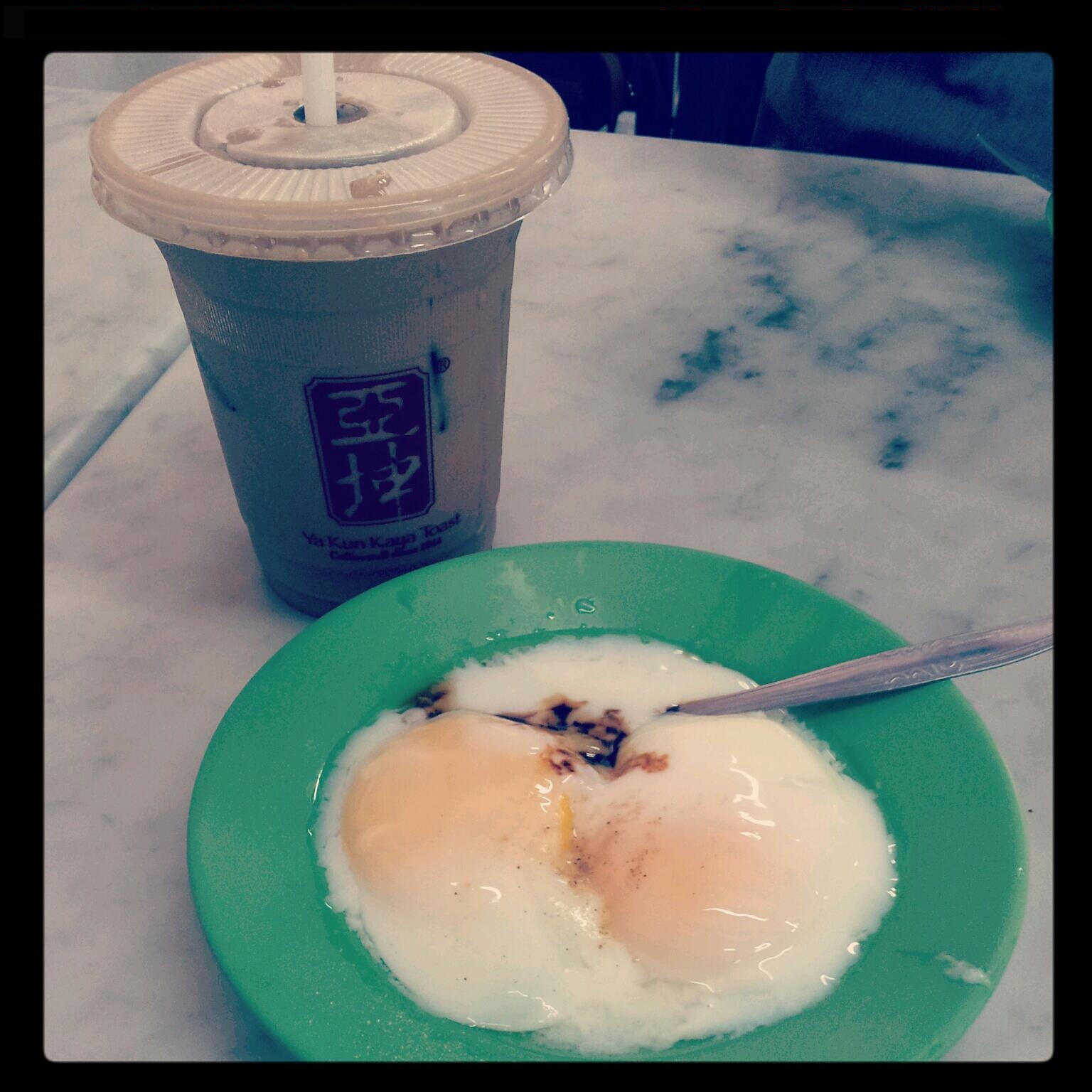
Breakfast of kaya toast and runny eggs at Ya Kun Kaya Toast before taking the MRT to Eastern Singapore for a Malay Wedding. Lunch? A buffet of various foods and flavors I've never tried in my life. Gorging ensues for a few hours until it's time to go to Little India. Before the Mustafa Centre, it's a "small" snack of roti prata at Teka Market, another hawker center. A quick pre-dinner drink and snack by the bay, followed by  dinner of various pork goodies, such as skin, intestine, stomach, chitlins, and the like, soon followed by a second dinner of hor fun (like chow fun, like chow mein, but with flat rice noodles) and frog porridge in Geylang, the red-light district. Dessert? The king of fruits, the ubiquitous durian.


Kopi O and Runny Eggs--Simply Delicious 

Buffet at the wedding. An incredible ceremony followed, and unlike anything I've ever seen. Video coming soon.

Mmmm... unrecognizable pig parts...

Never tried durian? It's... quite the experience. 

Still one more day.


Day 3:

Runny eggs and toast again at a local coffee shop. Morning at the Singapore Zoo, so a slight (and much needed) reprieve before lunch of fish and chips. Some more boba to top it off, and then off to Newton Circus Food Centre for an early dinner of sea snails, grilled stingray, calamari, and seafood hor fun. Updated my blog about Singlish, and then a well-deserved snack of praata and a paper-like version of it before off to see the Avengers (no room for popcorn, though I did think about it...).

Baby Squid. Crunchy and satisfying.

A sort of prata, paper thin and rolled into a cone. 


Wow... really? All that in 3 days? After typing it out, I'm kind of disgusted with myself. Granted, it was my Singaporean friend who sent me this list, with the goal of trying as much as possible before I left. And though I felt like I ate a lot, and I did... I didn't eat nearly enough. I left with restaurants left un-visited and food left untried. For example, I never went to the biryani place in Little India, ran out of time for sisig in the basement of Lucky Plaza, or didn't even make it to Golden Mile Complex for some Thai food. Hence, a foodie's nightmare--you're never satisfied. It's an addiction, always trying to get your next fix, from one taste to the next. I'm not even exaggerating when I say there was always talk about the next meal before even finishing the one in front of us.

Maybe the word nightmare is too harsh--I mean, what kind of nightmare would you voluntarily live through again?

Because when it comes to Singapore, I'll be back for seconds.